
How to sell SEO services to local businesses
How to Sell Local SEO Services as a Freelancer
Learn a local SEO sales process: who to target, discovery call flow, local audit lead magnet, packages, objections, and a 30/60/90 close plan.
Selling SEO to local businesses is harder than selling “rankings.” They usually care about calls, booked appointments, and leads you can trace back to the map results.
This guide gives you a repeatable sales process—from who to target to what to promise to how to close—so you can build a pipeline without sounding like every other agency.

1) Who counts as “local businesses” for SEO sales?
Before you pitch, define the room you’re selling into. “Local” can mean very different things, and your offer changes with it.
Service-area vs single-location
- Single-location businesses (one address people visit): e.g., dentist, gym, boutique.
- Service-area businesses (no store front; serve neighborhoods): e.g., HVAC, roofing, cleaning.
Local SEO is still about visibility in “near me” searches, but for service-area businesses you also need to be careful with location signals so you don’t promise coverage you can’t support.
Multi-location: where deals get bigger
If a business has multiple locations (or franchises), you’ll usually sell more work. But you may also face more stakeholders and harder data cleanup.
Quick rule: if they can name every location and share consistent business details (name, address, phone), you can move fast.
Takeaway: your best early clients are the ones with clear locations and messy-but-fixable local signals.
Common local niches where SEO budgets exist
Look for businesses that:
- already run ads and want cheaper leads
- have high-margin services (so CAC is doable)
- get judged by reviews (plumbers, medspas, legal services)
- depend on calls (home services, local consults)
Examples of local niches to start with:
- Home services: HVAC, plumbing, pest control
- Health & wellness: chiropractors, dental, PT
- Legal & finance: tax prep, local attorneys
- Professional services: design studios, photographers (with bookings)
- Local education & training: coding bootcamps, tutoring centers
2) What to promise besides rankings (your local SEO positioning)
Local business owners don’t wake up thinking about “top 3 in the SERPs.” They think: “Can I get more calls this month?” Your job is to translate SEO into measurable business outcomes.
Promise outcomes you can track
Instead of “we’ll improve rankings,” lead with a small set of outcomes:
- More calls / form fills from the map pack
- More booked appointments (or quote requests)
- Better review signals (more velocity and better consistency)
- More qualified local traffic (the right people, not just more visitors)
You can also offer “proxy” metrics that local owners understand:
- direction requests from Google Maps
- visibility for local keywords tied to service areas
- improved click-through from search results
Use a simple promise structure
Try this formula on your calls:
- what’s likely broken (local visibility + conversion signals)
- what you’ll improve (GBP, on-site local pages, citations/consistency, reviews)
- how you’ll measure progress (leads, calls, form fills, and local search engagement)
A clean “first month” expectation
Local SEO is not instant. But you should be able to show progress fast.
Your first month promise often looks like:
- local audit + action plan
- GBP fixes and category strategy
- on-site local landing page updates (or drafts)
- review plan + basic citation cleanup
3) Discovery call flow for local SEO (what to ask, in order)
If your discovery call feels random, your proposal will too. Here’s a flow that works for most service-area and single-location businesses.
Step 1: confirm the goal in their words (5 minutes)
Ask:
- “What would a win look like in 90 days?”
- “What currently drives your best leads—calls, forms, or walk-ins?”
- “Are you trying to grow one main service or expand into new ones?”
Listen for the business outcome and the timeline. Your packages should match.
Step 2: map their local footprint (5–8 minutes)
Ask:
- “Do you have one location or multiple?”
- “Do you serve a radius or specific cities/areas?”
- “What’s your service area list (even rough)?”
If they can’t list areas, it’s a sign you’ll need to build landing pages carefully.
Step 3: review current assets (10 minutes)
You’re looking for local basics you can improve.
Checklist prompts:
- Google Business Profile (GBP):
- “Have you claimed your GBP?”
- “Do you have the right primary and secondary categories?”
- “How often do you get reviews?”
- Website basics:
- “Do you have dedicated service + location pages?”
- “Do pages mention the service area naturally?”
- NAP consistency: (Name, Address, Phone across the web)
- “Do your business details match everywhere? What phone number do you use?”
- Citations/review sites:
- “Where else do customers find you?” (Yelp, Angi, Nextdoor, local directories)
- Conversion tracking:
- “How do you track leads?”
- “Do you know if calls come from Google?”
Step 4: pain + current solution (7 minutes)
Ask:
- “What have you tried so far—ads, an agency, DIY SEO?”
- “What’s not working?”
- “What do you think is the main reason you’re not getting enough leads?”
This helps you position your audit as the fastest path to clarity.
Step 5: budget reality without killing momentum (5 minutes)
Ask gently:
- “What range are you comfortable with for lead generation this quarter?”
- “If we can increase qualified leads, what would that be worth to you?”
Don’t demand a number first. Let them anchor.
4) Make an audit your lead magnet (local SEO audit that closes)
Generic audits don’t sell. Local audits should find business-impact problems.
What to include in a local audit (deliverable checklist)
Organize findings into “Fix first / Next / Later.” Focus on what can affect local visibility and conversion.
GBP (Google Business Profile) findings to check
- category selection (primary vs secondary)
- business description and services mentioned
- photos and recent updates
- review velocity + response habits
- service areas and hours
NAP consistency & citations
- name/address/phone mismatches
- duplicates or wrong phone numbers
- missing key directories where customers search
On-site local landing pages
- do they have service + location pages (or at least location sections)
- do pages clearly match their GBP services
- do pages include the service area in plain language
Conversion basics
- call button and form clarity
- whether each page answers “can you help me here?”
Talk track: how to frame the audit
You can say:
- “This audit isn’t about pages with red X’s. It’s about which local signals are limiting calls and bookings.”
- “I’ll show you what to fix first in 30 days, then what builds momentum after.”
Use the audit to run a second call
Turn the audit into a sales moment:
- send it before your proposal meeting
- walk through the top 3 issues and the expected impact
That “explain the why” step dramatically reduces objections.
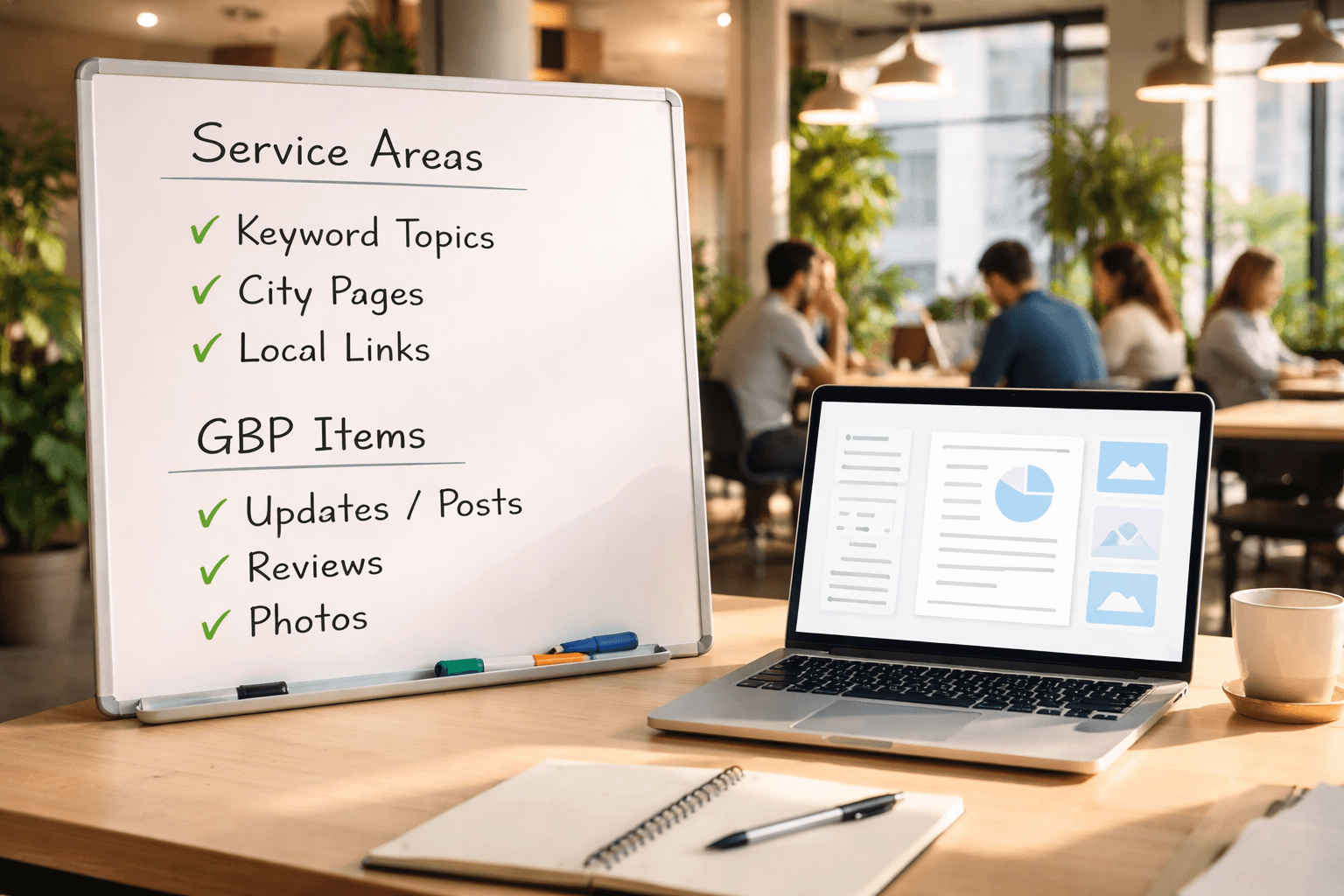
5) Packages and pricing options (starter + ongoing)
Local SEO sales works best when you sell a clear sequence.
Start with two package types
Most freelancers should sell:
- Starter (audit + setup fixes): 2–4 weeks
- Ongoing (growth + optimization): monthly
Example offer bullets (copy ideas)
These are examples you can adapt to your niche.
Local SEO Starter (first 30 days)
- GBP category + service area review and updates
- NAP consistency scan and a cleanup plan
- Local landing page improvements (rewrite/structure based on gaps)
- Review capture plan (simple process + templates)
- “30/60/90 local SEO roadmap” included
Ongoing Local SEO (monthly retainer)
- monthly GBP optimization + post/review plan support
- local landing page iteration (new sections, FAQs, service additions)
- citation cleanup + monitor changes
- local content plan based on what’s converting (not vanity)
- reporting focused on leads and local engagement
Pricing structure options to consider
- Fixed monthly: simplest for SMBs.
- Monthly + included hours: if you do ongoing page updates.
- Starter fixed + ongoing fixed: often the easiest decision.
To avoid scope creep, define what is included and what is “extra.” Local SEO projects get messy when you don’t.
Pro tip: align pricing to the business outcome
If they don’t have lead tracking, offer a lightweight setup step. You can price it as a one-time add-on if needed.
6) Handle the tough objections (with talk tracks)
Objection: “We don’t have much budget.”
Talk track:
- “That makes sense. Let’s focus on the fastest path to calls, not everything at once.”
- “We can start with a Starter package that fixes the biggest local blockers and decide after 30 days.”
Solution: offer Starter first, or a smaller monthly plan.
Objection: “We already have an agency.”
Talk track:
- “Totally fair. I’m not trying to replace anyone blindly.”
- “If you’re open, I’ll review what they’re doing for GBP categories, NAP consistency, and local landing pages. If there are gaps, we’ll map them—if not, you’ll know it’s covered.”
This positions you as helpful and reduces defensiveness.
Objection: “DIY SEO is fine for us.”
Talk track:
- “DIY can work if you have time and a consistent review + update routine.”
- “Most local businesses don’t. The gap is usually not effort—it’s missing the right sequence and consistency across the web.”
Then propose a small audit + setup plan.
Objection: “SEO takes too long.”
Talk track:
- “Agreed—rankings take time. That’s why we measure early wins: GBP improvements, landing page fixes, and review signals that impact clicks and calls sooner.”
Objection: “What if I don’t get results?”
Be careful with promises.
- “I can’t control Google’s algorithm, but I can control the work and the quality of local signals.”
- “We’ll set clear monthly goals and review performance. If we’re not moving, we adjust.”
7) Close with a 30/60/90 plan (make it feel safe)
A local SEO 30/60/90 plan helps buyers visualize progress. It also prevents you from selling vague “growth.”
30 days: fix the blockers
- GBP category + services update
- NAP consistency plan and key corrections
- landing page updates for local relevance
- review capture process started
60 days: build momentum
- improve/expand local pages based on what converts
- continue citation cleanup and monitoring
- optimize GBP posts, services, and photos
- tighten conversion paths (call/form)
90 days: show learning + next steps
- report on lead signals and local engagement
- double down on pages/services that convert
- adjust service area strategy if needed
- plan next quarter content and GBP cadence
Your close should feel like a roadmap, not a gamble.
A quick “tooling + workflow” note (so sales doesn’t turn messy)
When you’re juggling audits, follow-ups, proposals, and scheduling, it helps to centralize lead capture and communication. A platform like Jolix can connect your sales pipeline (lead forms → proposals → client portal) so the next step after each call is obvious—both to you and your client.
If you want a fast gut-check on where your freelance ops might be leaking leads or slowing closes, use the Freelance Business Check.

Your local SEO sales checklist (use it before every proposal)
- We defined local scope (single-location vs service-area vs multi-location)
- Client goal is clear (calls, bookings, forms, walk-ins)
- GBP health reviewed (categories, services, review signals)
- NAP consistency checked
- Local landing pages assessed (service + location coverage)
- Conversion path confirmed (call/form tracking)
- Audit findings translated into “Fix first / Next / Later”
- Package matches business urgency (Starter + ongoing)
- Objections covered (budget, DIY, existing agency)
- 30/60/90 plan included in the proposal
Related reading: LinkedIn for Freelancers: Get Noticed & Win Inquiries · Freelance UX Designer: How to Get Clients & Run Projects
A few example “local offer” variations you can pitch
For plumbers (high call intent)
- “We’ll optimize GBP and landing pages so you show up for the right emergency and service searches, and make it easy to call right away.”
For dental/clinics (reviews matter)
- “We’ll focus on review velocity and conversion pages, so more people choose you after searching locally.”
For service-area HVAC (radius clarity)
- “We’ll clean up service area signals and build landing pages that match the towns you actually serve.”
For legal services (trust + clarity)
- “We’ll improve local visibility signals and tighten your service/location pages so potential clients can tell they’re in the right place.”
---## Final thought: sell clarity, not SEO jargon Local business owners buy when you make the plan feel clear and the outcome feel reachable. Your job is to translate local search into calls and bookings, show the gaps in their current setup, and propose a sequence that reduces risk.
If you’d like to keep your lead → audit → proposal → onboarding flow organized in one place, Jolix can help you run the process without spreadsheets and scattered messages.