
freelance tax deductions
Freelance Tax Deductions: A Simple Deductions Map
Get a clear map of freelance tax deductions: what counts, common categories, what paperwork to keep, and quick checklists by expense.
You pay enough attention to clients and invoices. Taxes shouldn’t be a second full-time job. This guide is a freelancer-friendly “deductions map” so you can spot what usually qualifies as freelance tax deductions, what doesn’t, and what paperwork to keep.

1) The core rule: deductible vs. not
Most freelancers can deduct expenses that meet two ideas:
- They are ordinary and necessary. “Ordinary” means common in your line of work. “Necessary” means helpful for you to do the work.
- They are for your business, not personal use. If you also use something at home or for yourself, only the business portion is deductible.
A quick example: if you buy a microphone for recording client videos, that’s likely deductible. If you buy the same microphone because you want to start a hobby podcast on the side, you still may deduct part of it, but you’ll need a reasonable way to split personal vs. business use.
What usually does not count
These show up a lot in freelancer questions:
- Fines and penalties (like late fees or penalties from agencies).
- Illegal activity expenses.
- Personal expenses that aren’t tied to business work.
- Improvements that must be capitalized (some larger purchases, depending on what it is).
Because rules can vary by situation, treat the map below as a starting point—not final legal advice.
2) Typical freelance deduction categories (your “map”)
Think of your expenses in buckets. For each bucket, the goal is the same: prove it relates to your freelance work and show how you calculated any business-use portion.
Home office (and why it’s often misunderstood)
Home office can qualify when you use part of your home regularly and exclusively for business. “Exclusive” usually means it’s not also used for personal activities.
Common examples:
- A dedicated room used for client work and calls.
- A specific area (like a desk setup) where you don’t use the space for personal purposes.
Expenses that may fall under home office (depending on your method and eligibility): rent, mortgage interest, property taxes, utilities, and some repairs/maintenance.
Internet, phone, and utilities
If you use the internet and phone for client work, you can usually deduct the business portion. If your plan also supports personal use (almost everyone’s does), you’ll need a reasonable split.
Software, subscriptions, and tools
Many freelancers forget that software costs count.
Examples:
- Project management tools, design tools, audio/video tools.
- Stock photo subscriptions.
- Grammar checkers, e-sign tools, accounting apps.
If the software is mixed-use, again, deduct only what’s for business.
Office supplies and postage
This is the “small stuff” bucket, but it adds up.
- Paper, printer ink, notebooks.
- Shipping and postage for client work.
Tools and equipment
If you buy equipment (laptop accessories, cameras, microphones, specialized tools), it may be deductible.
The key detail: larger purchases may need different treatment than day-to-day expenses. If you’re unsure whether something is an immediate expense or handled differently, keep the receipt and ask your tax professional.
Marketing and client acquisition
This bucket often feels obvious, but it’s worth spelling out:
- Website hosting and domain.
- Ads (social, search, sponsored posts).
- Business cards, brand assets.
- Event fees if the purpose is promoting your services.
Professional services
If you pay others to help your business, it can be deductible:
- Accountants and tax prep.
- Legal fees (contracts, disputes, entity setup).
- Bookkeeping help.
- Consulting for business planning.
Insurance
Common policies that may qualify include:
- Health insurance (rules can be more complex).
- Professional liability (errors and omissions) or similar coverage.
- Business property insurance.
Insurance can be a big one—keep the policy documents.
Travel
Travel can be deductible when it’s primarily for business.
Examples:
- Conference travel to speak or attend for work.
- Flying or driving to meet clients (and related expenses like lodging).
You’ll typically need to track dates, destinations, and the business purpose.
Meals
Meals can be tricky because rules vary by circumstances. If meals are business-related (for example, with a client or while traveling for business), you may be able to deduct part.
Best practice: keep a receipt and note who you met and why it mattered.
Education and training
If education helps you maintain or improve skills in your current business, it may be deductible.
Examples:
- A paid course to learn a software you already use professionally.
- Training related to your services.
Education that qualifies you for a new trade or business may be treated differently. When in doubt, save the course info and talk to a professional.
Car and mileage
If you drive for client work, you may deduct either:
- Actual expenses (gas, maintenance, insurance, etc. allocated to business), or
- Mileage (tracking miles for business use).
You’ll need clear records: where you went, business purpose, and date.
3) Documentation expectations (what to keep)
Most tax pain for freelancers comes from weak records, not from missing categories. Here’s what usually matters:
Receipts and proof
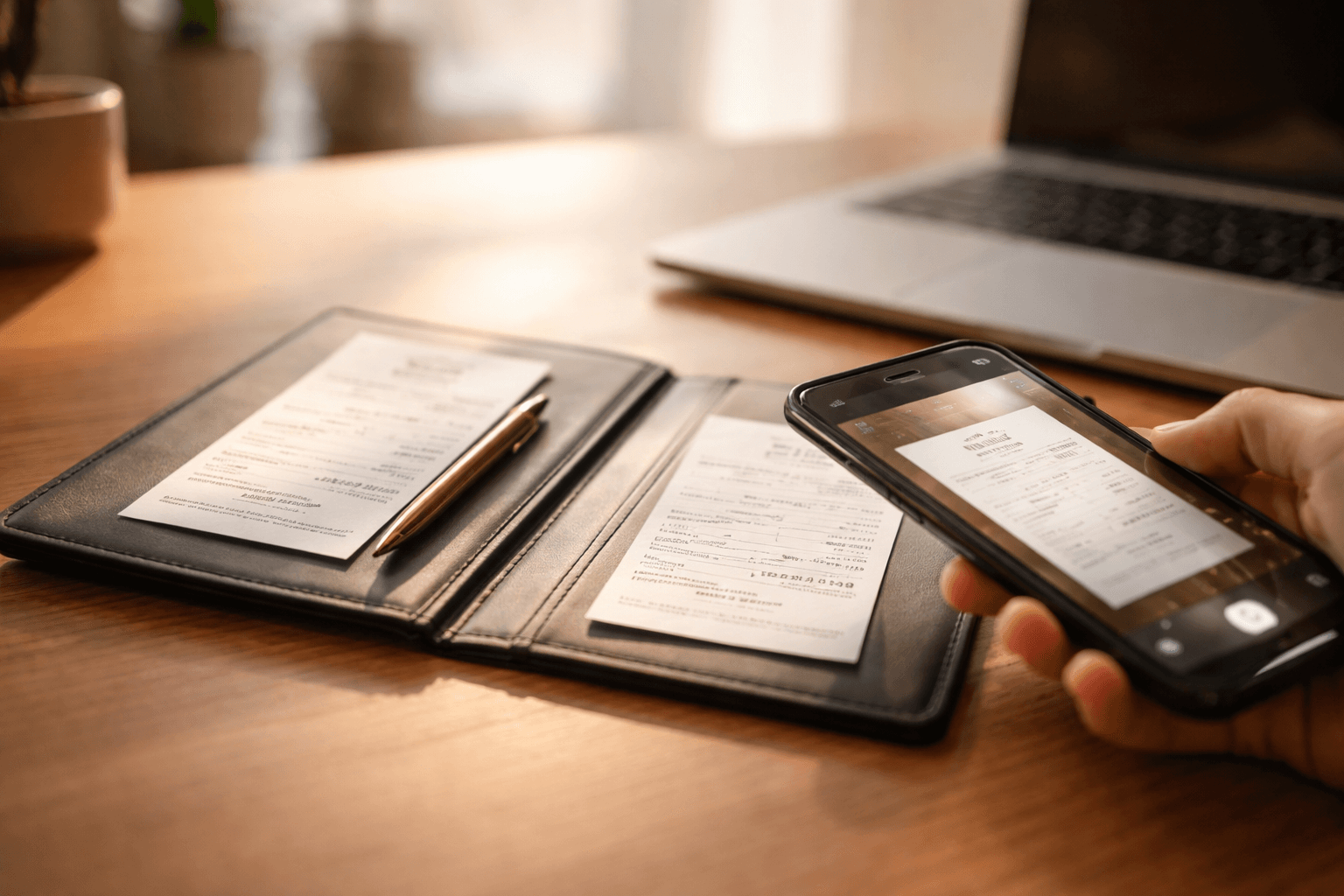
- Keep receipts for purchases (digital is fine).
- Keep invoices and bank/credit card statements that show amounts and dates.
- Save subscription invoices (email receipts are usually enough).
Notes that explain the “why”
Some expenses need a short story to match the rules:
- Travel: destination, dates, business purpose.
- Meals: who you met, why it was business.
- Car: start/end odometer (or mileage log), purpose.
- Home office: how the space meets the “exclusive” requirement.
A simple system works
You do not need perfection. You need consistency.
- Keep everything in one place by year.
- Name files like
2026-03-meeting-lunch-client-receipt.pdf. - Make one monthly pass: reconcile purchases and tag them to the right category.
If you’re juggling proposals, contracts, and invoicing, it helps when your client communications and files are centralized too—tools like Jolix can support that “single place to work” approach so receipts, notes, and client records aren’t scattered across apps.
4) Common freelancer misconceptions (and what to do instead)
“If it’s business-related, I can deduct 100%.”
Not always. If it has personal use (internet, phone, computer, car, home), you generally deduct only the business portion.
Fix: estimate a reasonable percentage and keep your logic.
“I can deduct stuff I forgot to track.”
You might be able to, but it’s harder. Many deductions require receipts or proof.
Fix: save receipts immediately and do a quick monthly cleanup.
“Meals are automatically deductible.”
Not automatically. Rules depend on the situation.
Fix: keep receipts and your notes on business purpose.
“Education is always deductible.”
Education can qualify, but if it’s for a new trade or business, it may be treated differently.
Fix: keep course details and ask before filing if you’re unsure.
“Home office is only for people with separate rooms.”
Often it’s easier when you have a dedicated room, but the rule is about how you use the space. What matters is regular use and exclusive business use.
Fix: document how the space is set up and used.
5) Quick checklist by category
Use this as your fast “what should I keep?” list.
Home office
- Measurements or setup description
- Proof of housing costs (rent/mortgage, utilities)
- Evidence the space is used regularly for business
Internet & phone
- Plan invoices or statements
- Estimate of business use portion
Software & subscriptions
- Invoices/receipts for each subscription
- Notes if mixed personal/business use
Office supplies
- Receipts
- Brief notes if bought for a specific client project
Tools & equipment
- Receipts for purchases
- When/why it supports your services
Marketing
- Receipts for ads and promotions
- Records for website costs
Professional services
- Invoices from accountants, lawyers, contractors
Insurance
- Policy documents and payment receipts
Travel
- Itinerary (dates/destination)
- Receipts for lodging/transport
- Notes on business purpose
Meals
- Receipt
- Who attended and why it was business
Education
- Course invoice
- Description of how it relates to your current work
Car & mileage
- Mileage log or actual expense records
- Notes on business trips
Related reading: What Insurance Do Freelancers Need to Start? · What to Include in a Freelance Contract (Checklist)
6) Next steps: turn this map into a plan
A deductions map is a great start. The next step is making sure you’re tracking expenses from day one and categorizing them the same way all year.
If you want to sanity-check where your business might be leaking time or money, run a quick review with the Freelance Business Check. It’s designed to help freelancers spot operational gaps that often show up during tax time.
Then, pick one category to go deeper. For example:
- Home office rules and how to document them
- Mileage vs. actual expense tracking
- How to handle mixed-use technology (laptop, phone, internet)
- What to do about big purchases (equipment vs. day-to-day expenses)
The best time to organize deductions is before you need them.

A simple workflow you can start today
- Gather last year’s receipts (or whatever you have) and sort by category.
- Set up a “Receipts” folder for the current year.
- Do a 10-minute monthly check: confirm each expense has a receipt and a category.
- Before big purchases, decide where it fits (and whether it might be handled differently).
If you keep your system simple, you’ll spend less time chasing documents and more time doing billable work.