
best freelance skills to learn
Best Freelance Skills to Learn: Find Your Niche Fast
A “best skills” roundup for freelancers: demand, pay timeline, portfolio fit, recurring potential. Plus a simple way to pick one skill.
What “best skills” actually means (your freelancer scorecard)
When you’re trying to choose from many freelance options, “best” should mean best for you, fastest to monetize, and easiest to show in a portfolio.
Use this simple scorecard. Give each skill a 1–5 score:
- Demand you can actually find: Are clients already hiring for it on common platforms or job boards?
- Monetization timeline: Can you sell something within 2–6 weeks (not just “learn for months”)?
- Portfolio friendliness: Can you create clear proof (samples, case studies, demos) without needing huge experience?
- Recurring potential: Is there a reason clients buy again (maintenance, retainers, ongoing needs, upgrades)?
Tip: If a skill scores high but you can’t picture your first deliverable, it’s probably not a good “learn next” choice.
1) Demand you can actually find
Demand is your reality check. A skill is only useful if clients request it in plain language.
Look for signals like:
- Specific deliverables mentioned (e.g., “landing page copy,” “logo for packaging,” “Shopify product page design”)
- Repeated hiring patterns (the same type of work shows up again and again)
- Clear budgets or rates (even if you start low)
A good goal: pick skills where you can answer, “Yes, clients ask for this every week.”
2) Monetization timeline (how fast you can sell)
Some skills take years. Other skills let you sell quickly because you can ship a focused outcome.
Quick monetization usually comes from:
- Smaller deliverables (templates, audits, page sets, ad copy bundles)
- Repeatable processes (checklists, reusable workflows)
- Measurable results (before/after, improvements, conversion-focused outputs)
If your first paid project would be “someday,” that’s a red flag.

3) Portfolio friendliness
Clients hire based on proof. You don’t need a fancy agency background—you need credible samples.
Portfolio-friendly skills let you create:
- Mock deliverables (realistic redesigns, sample campaigns, sample landing pages)
- Demos (small apps, automations, prototypes)
- Mini case studies (problem → approach → results you can measure)
Even one strong sample beats ten vague ones.
4) Recurring potential (will clients keep buying?)
One-time work is fine when you’re starting, but recurring revenue helps freelancers stabilize.
Recurring signals include:
- Ongoing needs (content schedules, SEO updates, social posting)
- Maintenance work (bug fixes, plugin updates, performance checks)
- System upgrades (new landing pages, new automations, new workflows)
Aim for at least one path from “first project” to “ongoing client work.”
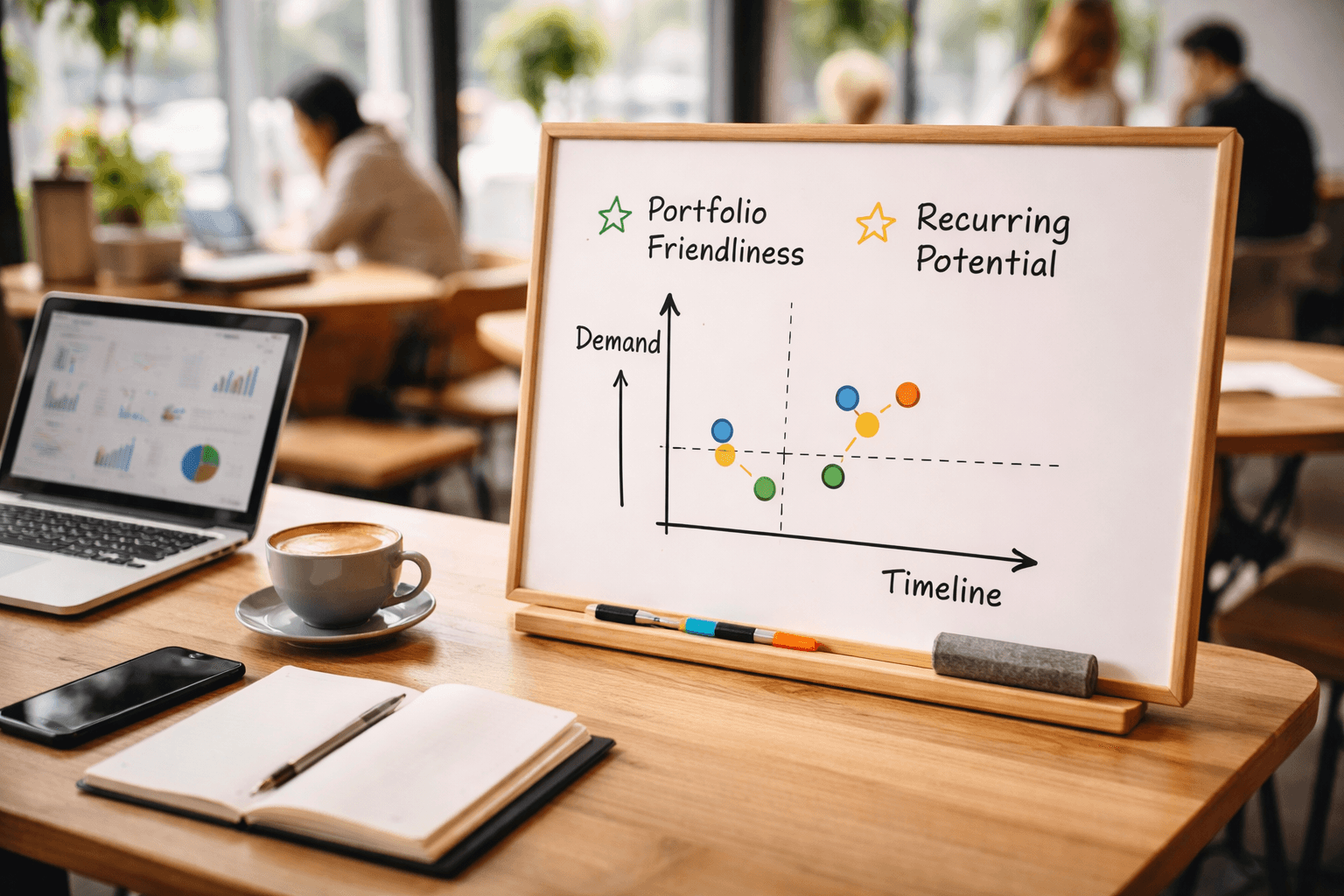
The best freelance skills to learn (grouped by freelance type)
Below are 13 practical skills that tend to score well on demand, monetization timeline, portfolio friendliness, and recurring potential.
For each one, you’ll see:
- Best buyer/industry
- Typical deliverables
- Learning time estimate
- Easy first project idea
Writing & Content (for freelancers who like structure + clarity)
1) Website copywriting (conversion-focused)
- Best buyer/industry: Coaches, agencies, local services, SaaS landing pages
- Typical deliverables: Homepage + service page copy, landing page sections, email welcome sequences
- Learning time estimate: 3–6 weeks
- Easy first project idea: Write a conversion-first “Service Page Starter Kit” for a business you can choose (headline, value prop, FAQ, and CTA sections).
2) SEO content writing (for specific topics)
- Best buyer/industry: E-commerce brands, B2B blogs, local businesses targeting search
- Typical deliverables: Blog posts for a keyword cluster, product guide content, FAQs
- Learning time estimate: 4–8 weeks
- Easy first project idea: Build a mini topic cluster (3 posts) with outlines, search intent notes, and a final draft for one article.
3) Email marketing (copy + simple flows)
- Best buyer/industry: E-commerce, subscription brands, online courses
- Typical deliverables: Welcome sequence, abandoned cart series, newsletter templates
- Learning time estimate: 3–6 weeks
- Easy first project idea: Create a 5-email welcome sequence for a fictional or local brand offer (include subject lines and CTA goals).
Design (for freelancers who can produce artifacts quickly)
4) Brand identity basics (logo + starter system)
- Best buyer/industry: Startups, founders, small agencies, rebrands
- Typical deliverables: Logo set, color palette, type suggestions, basic brand guidelines
- Learning time estimate: 4–10 weeks
- Easy first project idea: Redesign the brand kit for a local business (logo options, color palette, one social post mockup).
5) Social media design (templates + batch packs)
- Best buyer/industry: Coaches, creators, small businesses
- Typical deliverables: Post templates (Canva or Figma), story templates, content packs
- Learning time estimate: 2–5 weeks
- Easy first project idea: Make a 20-template “Content Pack” for a niche (e.g., real estate tips, fitness progress, or wedding planning).
6) Landing page design (conversion layout)
- Best buyer/industry: Local services, B2B lead gen, course sales
- Typical deliverables: Landing page layouts, wireframe + design, responsive mockups
- Learning time estimate: 4–8 weeks
- Easy first project idea: Design a landing page for a real offer (choose one): hero section, benefits, testimonials, pricing block, and FAQ.
Development (best for those who enjoy building and shipping)
7) WordPress site customization
- Best buyer/industry: Small businesses using existing themes, content-heavy sites
- Typical deliverables: Theme tweaks, page builds, layout fixes, plugin setup
- Learning time estimate: 6–12 weeks
- Easy first project idea: Take one existing WordPress site and rebuild one key page with clear improvements (faster layout, better sections, mobile styling).
8) Web automation (no-code + light scripting)
- Best buyer/industry: Agencies, e-commerce teams, operators who hate repetitive tasks
- Typical deliverables: Form-to-spreadsheet workflows, email triggers, CRM updates, scheduled reports
- Learning time estimate: 3–8 weeks
- Easy first project idea: Build an “inbox to CRM” automation: when a form is submitted, it creates a row, sends a confirmation email, and notifies a channel.
9) Shopify product page optimization
- Best buyer/industry: Shopify store owners, DTC brands
- Typical deliverables: Product page layouts, theme sections, upsell blocks, speed fixes
- Learning time estimate: 4–10 weeks
- Easy first project idea: Improve one product page: restructure sections, add FAQ, refine image layout, and propose an upsell section.
Marketing (skills that translate into repeat client revenue)
10) Paid ads (start with one platform)
- Best buyer/industry: E-commerce, online services, course brands
- Typical deliverables: Campaign setup, ad copy variations, landing page suggestions, basic reporting
- Learning time estimate: 4–10 weeks
- Easy first project idea: Create one campaign plan with 3 ad angles and a matching landing page outline (then test it if you have access, or show the plan as your sample).
11) Local SEO (Google Business Profile + on-page)
- Best buyer/industry: Dentists, plumbers, salons, contractors
- Typical deliverables: GBP optimization, service page improvements, review strategy planning
- Learning time estimate: 3–7 weeks
- Easy first project idea: Do a “Local SEO Reset” for one business: audit categories, services, photos, review links, and propose 10 updates.
12) Content repurposing for marketing teams
- Best buyer/industry: Agencies, creators with podcasts/videos, consultants
- Typical deliverables: Blog posts from webinars, LinkedIn threads from podcasts, short-form scripts
- Learning time estimate: 2–4 weeks
- Easy first project idea: Take one long video and repurpose it into: a blog outline, 5 LinkedIn posts, and 1 newsletter draft.
Ops & Automation (often overlooked, often easier to repeat)
13) Customer onboarding & SOP setup
- Best buyer/industry: Service businesses, small teams, agencies that onboard clients manually
- Typical deliverables: Onboarding checklists, SOP documents, handoff templates, client welcome workflows
- Learning time estimate: 2–5 weeks
- Easy first project idea: Create an onboarding system for a service you understand (discovery call → contract → kickoff → first milestone plan). Deliver it as a simple SOP.
Not sure where your freelance business stands? The Freelance Business Check is a quick way to spot weak spots before they turn into late nights or lost income.
How to choose ONE skill to learn next (without overthinking)
Use the steps below to narrow to one choice you can finish and sell.
Step 1: Pick your time window
Be honest about your schedule.
- If you have 2 weeks: choose a skill where you can ship a small sample (templates, audit, landing page mock, mini automation).
- If you have 1–2 months: aim for a deliverable you can show as a mini case study.
- If you have 3+ months: you can handle deeper building (web dev, stronger design systems, ads practice).
Step 2: Map to your strengths (and your tolerance)
Ask:
- Do I enjoy writing, explaining, and revising? → copywriting, email, SEO content
- Can I move fast and make clean visuals? → social templates, landing page design
- Do I like building and solving technical problems? → Shopify optimization, automation, WordPress customization
- Do I enjoy testing and improving campaigns? → local SEO, paid ads
- Do I like systems, checklists, and “making work smoother”? → SOPs and onboarding
Choose something you won’t dread for 30 days.
Step 3: Make proof your goal, not “learning”
Learning is the process. Proof is the product.
Write down:
- What will I deliver?
- How will it look in a portfolio?
- How will I describe the outcome (even if it’s a mock)?
Example goal: “I will publish a mini portfolio page with 3 before/after sections and a 1-page case study.”
Step 4: Validate with a quick “buyer test”
Before you commit, do a fast check:
- Find 10 real clients or businesses that match the skill’s best buyer.
- Read their websites, offers, or job posts.
- Write a one-sentence pitch for what you’d improve.
If you can’t describe how you’d help after 20–30 minutes, the skill may be the wrong fit.

Related reading: How to Start Freelancing: Your First 30 Days · Freelance Marketing Strategy: Your 90-Day Roadmap
Common mistakes when learning a freelance skill
Mistake 1: Learning too broadly
If you study 6 tools and 10 topics, you’ll delay your first deliverable.
Fix: Pick one skill + one buyer problem + one deliverable. Stop at “good enough to sell.”
Mistake 2: No niche (your portfolio looks generic)
“General content writer” and “general designer” are hard sells.
Fix: Choose a niche based on where you can find examples and repeat needs (e.g., local plumbers, Shopify brands, coaches, dentists).
Mistake 3: No proof of your ability
A portfolio with only practice notes won’t convince clients.
Fix: Build at least one artifact that looks like a real client deliverable.
Mistake 4: Choosing a skill with a slow monetization path
Some skills have a long ramp time. Fix: Prefer skills where you can produce a sample and pitch quickly (audit, template pack, landing page mock, automation workflow).
Mistake 5: Starting without a first-project plan
If you don’t know what your first paid project looks like, you’ll get stuck.
Fix: Write a “first project brief” before you start your course or training.
---## Your next action plan (short list + schedule) Here’s a simple plan you can follow this week.
- Choose 2–3 skills to evaluate for one week (use the scorecard above).
- Pick the one you can ship first.
- Build your first project brief in 30 minutes (deliverable, niche, and what proof you’ll show).
- Set a 14–30 day shipping target.
Quick checklist for day one:
- One niche you can talk to
- One deliverable you can finish
- One portfolio sample you can publish
If you want the fastest path, pick the skill that lets you show proof within a month, then iterate as clients respond.